Exhibition
Exhibition
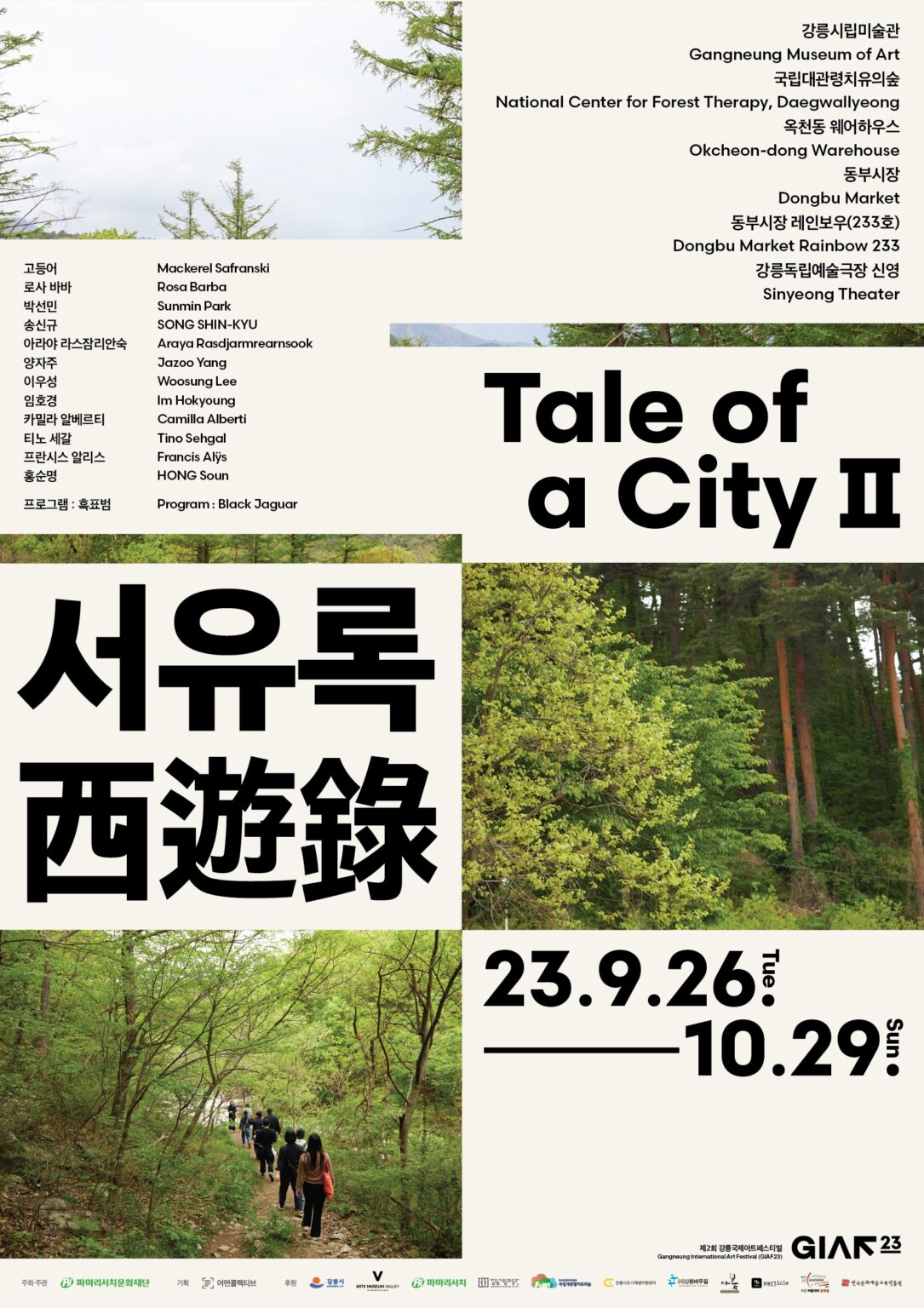
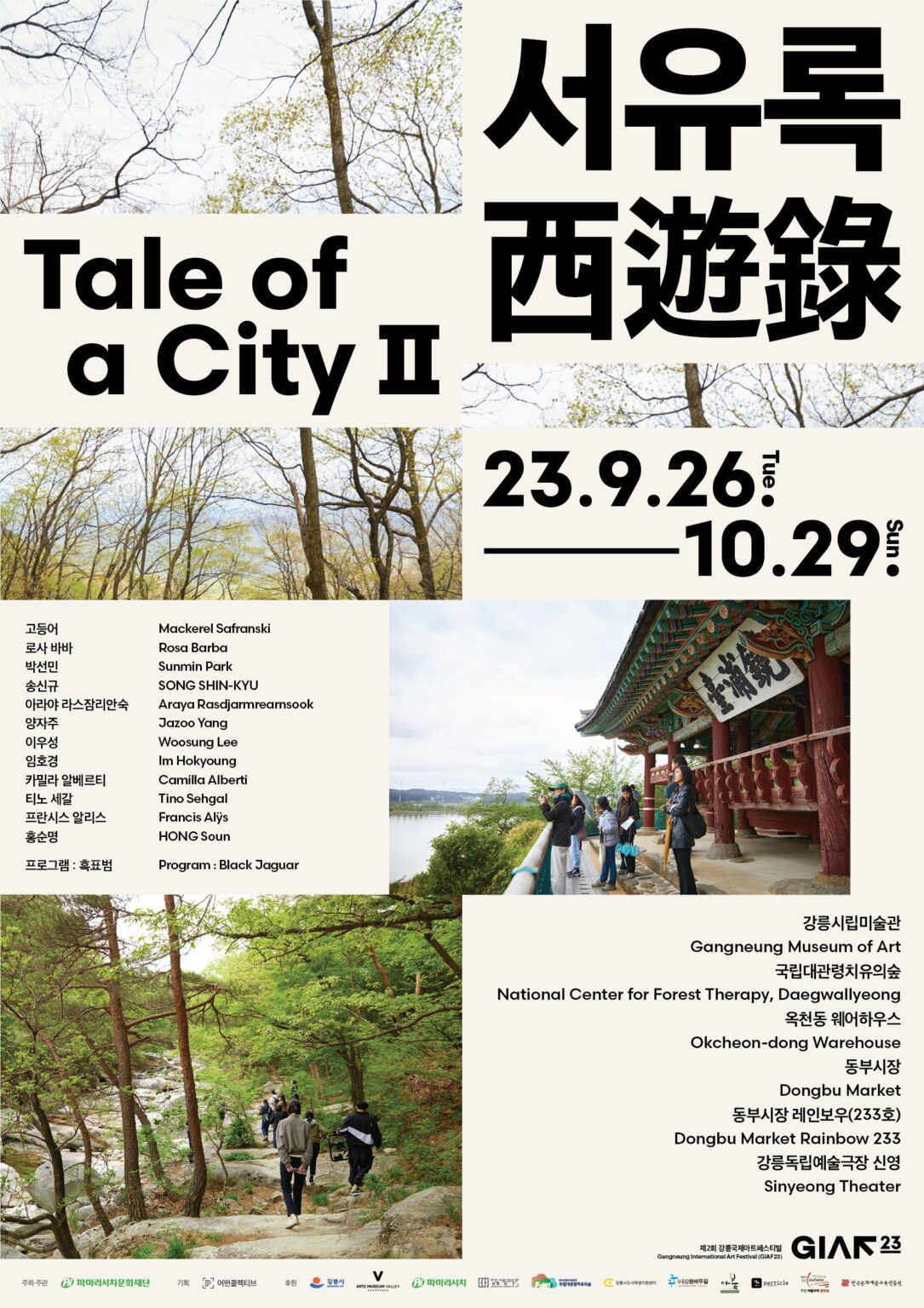
제2회 강릉국제아트페스티벌
Gangneung International Art Festival(GIAF23)
《서유록》 Tale of a City Ⅱ
Festival Period
September 26(Tue)-October 29(Sun) 2023
Free admissions
Opening Hours
Everyday 10:00-18:00
※ Each festival venue may operate on different schedules.
Venue & Artist
Gangneung Museum of Art
HONG Soun, SONG SHIN-KYU, Rosa Barba, Im Hokyoung, Araya Rasdjarmrearnsook, Camila Alberti
※ Closed on every Mondays
Closed on Chuseok Sep 29th(Fri) / Closed on Oct 4th(Wed), 10th(Tue) for an alternate schedule
following the normal opening hours on Oct 2nd, 9th(Mon).
National Center for Forest Therapy, Daegwallyeong
Tino Sehgal
Okcheon-dong Warehouse
Sunmin Park
Dongbu Market
Woosung Lee, Mackerel Safranski
Dongbu Market Rainbow 233
Woosung Lee, Mackerel Safranski, Jazoo Yang, Im Hokyoung
Sinyeong Theater
Francis Alÿs
※ Francis Alÿs, Sandlines, the Story of History(2020), Fri, Sat, Sun 16:00, Free admission
Booking tickets through official Instagram of Sinyeong Theater @indiesy via the link on bio.
Information
Tour Bus
Departing at Gangneung Station Exit 2 on every Friday, Saturday, and Sunday, 10:20 (First come, first serve)
Art Baugil
Departing at Gangneung Station Exit 2 on every Saturdays, 10:30
STAY Program reservation method
Information on the GIAF official website’s popup window and the link at the official Instagram @giaf.official
Audio Guide
Actress Cha Ye-ryun and actor Joo Sang-wook, the models of ‘REJURAN’, have
graciously lent their voices to narrate the audio guide for GIAF23. Meet them via the venues’ QR code and official application on Particle.
GIAF23 x Particle
Enjoy the festival any time and anywhere via official application, Particle.
Foreign language docent support
Available languages (English, Japanese, Russian, Chinese, Vietnamese, Indonesian, Mongolian, Thai)
Becoming Birds
Practice of Snakes, Water and Birds: popup window and link on the official Instagram @giaf.official for information
“Now, after a short break, I arrive on a hill called Wonulijae—a place that acquired its name through this story: the newly assigned district governor (Won in Korean) wept upon reaching the hill on the way to Gangneung and said, ‘How am I to serve such rugged land?’ When departing after the tenure, the governor stood on the hill, wept, and said, ‘I am leaving behind the best land that is Gangneung.’ Because the hill moved the governor to tears, it was named Wonulijae ( Won 員 Governor Uli 泣 To cry Jae 峴 Hill).”
An excerpt of the chapter “It’s a Shame to Miss Out on Seoul Till You Age” from the book Seo-Yu-Rok.
Seo-Yu-Rok*, the underlying theme and motive for the Gangneung International Art Festival 2023, is a travelog written by a woman known as Gangneung Kim, or Lady Kim of Gangneung. In 1913, at the age of 52, Kim left Gangneung for Seoul, returning after a 37-day journey. At a time when traveling as a woman was not as straightforward, Kim, accompanied by her family, traversed the winding mountain paths spanning over 200 kilometers on foot, taking over ten days to reach Seoul. Kim toured with excitement at the wonder of Seoul’s bustling landscape. Yet, she was also anguished by the presence of the Japanese colonial empire, which still held sway over the melancholic reality of Joseon (the last dynastic kingdom of Korea) in every corner. Furthermore, Kim’s interactions with educated women during the journey led her to recognize the necessity of women’s education within the societal context. Upon her return to Gangneung, Kim aspired to establish a girls’ school but faced challenges due to a lack of like-minded individuals and financial constraints. After her visit to Seoul, Kim returned to Gangneung over Daegwallyeong mountain. Here, Kim documented her encounters with the landscapes she came across, her experiences in Seoul, and the journey back to Gangneung.
“Next to Jaeminwon* in the town of Gulmyeoni** reaching Solgyeong,it was the entrance to Daegwallyeong.”
An excerpt from the book Seo-Yu-Rok.
Gangneung International Art Festival 2023 Tale of a City II is conceived based on Seo-Yu-Rok, a 37- day travelogue written by Gangneung Kim, or Lady Kim of Gangneung that chronicles her journey across the Daegwallyeong River in Gangneung towards Seoul in the west. The festival represents Kim as a ‘personal value realizer’ who made the long journey during the turbulent times of the early 1900s and interprets her as an activist, a brave challenger who advocated and practiced the importance of women’s education. Pivoting between familiarity and estrangement, the travel shifted Kim’s identity as well as provided a new perspective on her hometown, Gangneung.
Stimulated by Kim’s challenging spirit and actions, the festival gives close attention to all intertwining perceptions and emotional aspects that are in flux within time—our multifaceted interaction with the physical environment that is the city. By having Kim as the symbolic figure and a guiding presence manifested by all means, GIAF aims to inspire all visitors to gain a new perspective not only on Gangneung but also on their own ‘homes.’ Furthermore, GIAF expands the notion of ‘traveling’ as a physical act of detaching oneself for a certain period from where one once belonged, a definition that weaves throughout the festival.
As Kim concludes her story with a hope for her journey to be carried on, the festival wishes the topography of relationships formed this year to continue and last. GIAF would like to invite everyone, including organizers, artists, collaborators, and viewers to individually uncover this journey of unique estrangement, guided by Kim’s vision and senses.
** Gulmyeon-i: Gulmyeon-i (屈免洞) implies in its name: to evade (免) the rolling descent (屈). The place got its name because of all the travelers rolling and falling down. After navigating the challenging road of Daegwallyeong, they found the terrain in this village much easier to traverse, providing them comfort and ease as they continued their journey.
* Jeminwon (Jemyangi): Jemyangi (濟民院) is a name originating from Jeminwon, a lodging facility where government officials from central administration during the Joseon Dynasty would stay during their official travels. Jemyangi emerged as a place name due to the transformation of Jeminwon. Jeminwon was located between Gusan Station (located in Okcheon-dong) and Hwanggye Station (located in Hwanggye-ri, Daegwallyeong-myeon) as a rest area for officials on their way to and from the central region. Jemyangi was an ancient road connecting the Yeongdong and Yeongseo regions. It existed before the construction of the road that severed the Daegwallyeong mountain. resently, it is used as a hiking track on the old path of Daegwallyeong, attracting numerous hikers.
GIAF 사무국 경기도 성남시 수정구 금토로40번길 22, 3층 강원도 강릉시 과학단지로 57-9 (대전동) 031-696-3797~8


